If you need an emergency dentist in Kiambu right now, we are on the 8th floor of Kikinga House on Biashara Street, opposite Kiambu Level 5 Hospital, open 8am to 5pm every day including weekends. Walk in, or send a message on WhatsApp to 0143 178126 and we will tell you whether to come straight away. The line is answered outside those hours too, so a message at 11pm gets triaged and booked for first thing.
Before anything else, there is one group of symptoms that does not belong in a dental chair at all. Read the next section first, even if you are in a hurry, because it is the part that matters most.
Table of Contents
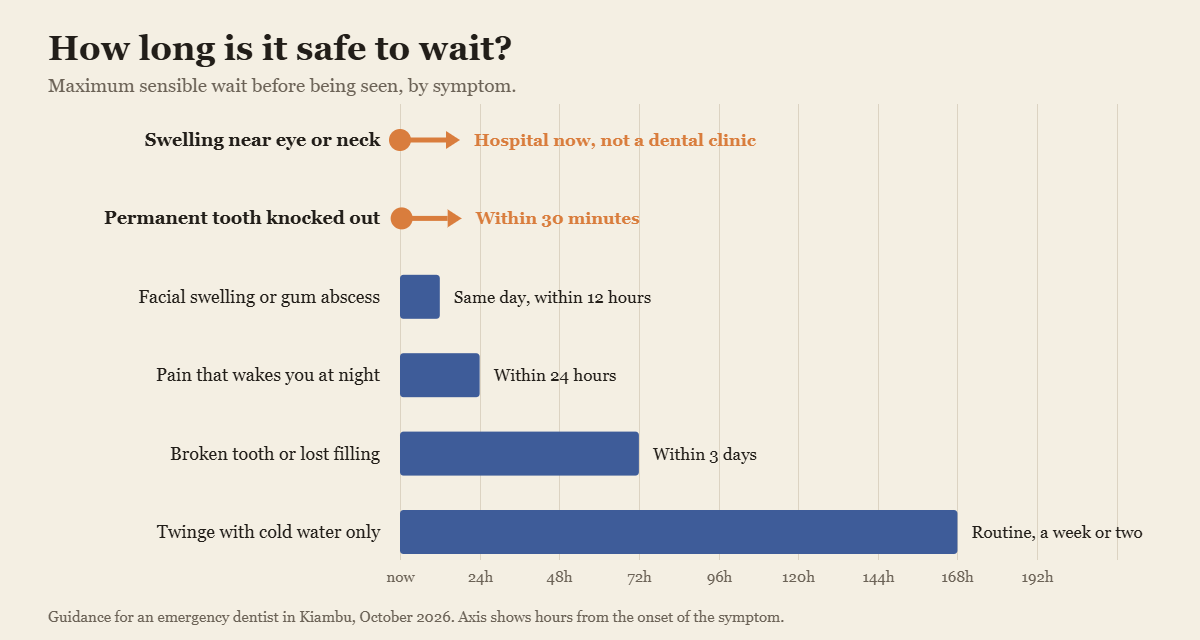
Go to a Hospital Now, Not a Dental Clinic, If Any of These Apply
- Swelling that has reached the area around your eye, or spread down into your neck
- Any difficulty breathing, swallowing or speaking
- Swelling that is closing your throat or making your voice sound different
- A high fever along with facial swelling
- Heavy bleeding that has not stopped after twenty minutes of firm pressure
These are signs that an infection from a tooth is spreading into the tissues of the face and neck, which is a medical emergency rather than a dental one. The NHS guidance on toothache is explicit that swelling around the eye or neck, or trouble breathing, swallowing or speaking, means emergency hospital care. Kiambu Level 5 Hospital is directly opposite our building. Go there, and deal with the tooth itself afterwards.
Everything below this point is about the far more common situation: a tooth that is hurting badly, a broken tooth, a lost filling, a swelling that is still local to the gum, or a knock to a front tooth.
What Counts as a Dental Emergency in Kenya
A useful test is whether the problem is getting worse by the hour rather than holding steady. A dental emergency in Kenya most often means one of six things, and the first three need seeing the same day.
- Severe tooth pain that is constant, throbbing, or waking you at night
- A swelling on the gum or face, with or without a bad taste, which usually means an abscess
- A tooth knocked out or pushed out of position by a blow
- A broken or cracked tooth with a sharp edge or exposed inner surface
- A lost filling or crown leaving the tooth sensitive to air and cold
- Bleeding or pain following a recent extraction that is worsening rather than settling
Pain that comes only with cold water and stops within seconds is a different matter. It still needs looking at, because it usually signals a cavity or a crack that will progress, but it does not need an emergency appointment tonight.
Why Look for an Emergency Dentist in Kiambu Rather Than Nairobi
When a tooth is throbbing, the journey matters as much as the clinic. An hour on Kiambu Road in traffic with an abscess is its own kind of misery, and it is time during which a swelling can get meaningfully worse. Finding an emergency dentist in Kiambu instead of driving into town is usually the difference between being seen this morning and being seen this afternoon.
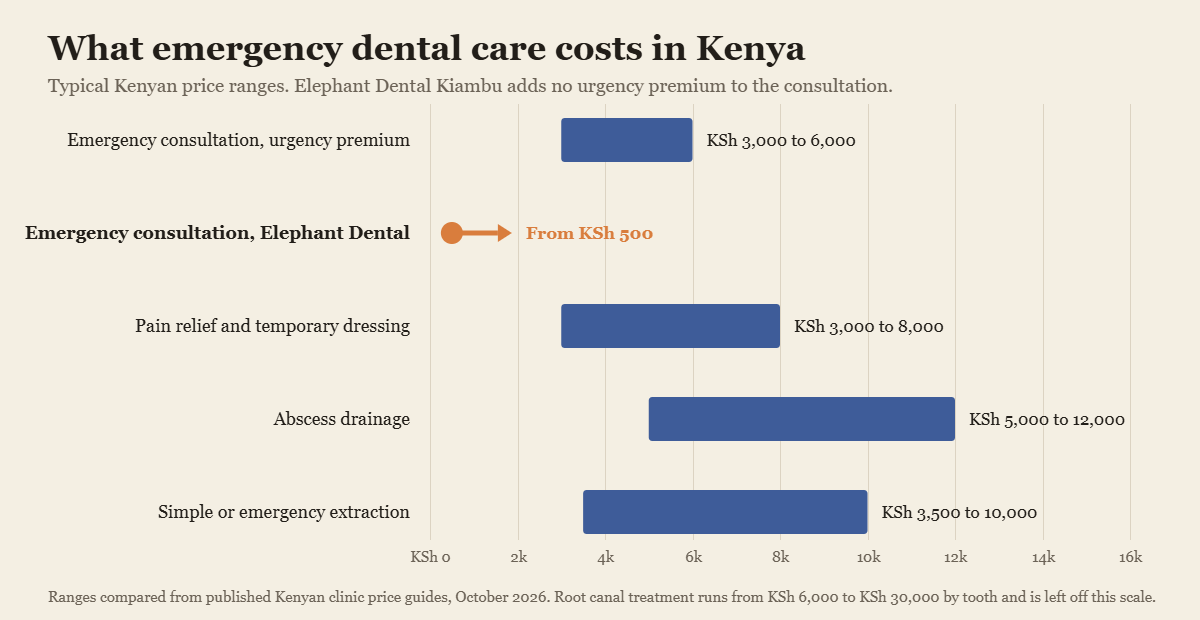
There is a cost element too. Clinics in central Nairobi and in private hospitals carry higher overheads, and several add an urgency premium on top for emergency dental care, which can mean paying noticeably more for the same drainage or the same emergency tooth extraction. An emergency dentist in Kiambu is working from a lower cost base before any premium is considered.
What you should not compromise on is registration. Anyone treating you must be registered with the Kenya Medical Practitioners and Dentists Council, and you are entitled to ask. Pain is a bad time to be cautious about credentials, which is exactly when it matters most.
What to Do Right Now, Before You Reach a Dentist
None of this treats the cause. All of it buys you a more comfortable few hours until someone can look at the tooth, and the NHS guidance linked above covers the same ground.
- Take paracetamol or ibuprofen at the dose printed on the packet, not above it
- Rinse gently with warm salty water, about half a teaspoon of salt in a cup
- Stick to soft, lukewarm food and avoid anything very hot, very cold or sweet
- Keep brushing, but use a soft brush and go gently around the sore tooth
- Do not floss around the painful tooth until it has been assessed
- Do not hold aspirin against the gum, which burns the tissue rather than helping
- Do not apply heat to a swelling, because warmth encourages infection to spread
If you are already taking other medication, or you are pregnant, check with a pharmacist before adding a painkiller. That is a thirty second conversation and it is free.
What to Do If Tooth Pain Is Unbearable at Night
Toothache at night reliably feels worse than the same tooth did at noon, and there is a reason for it. Lying flat raises blood pressure in the head, which increases pressure inside an already inflamed tooth. There is also nothing else competing for your attention at 2am, which is why toothache at night feels so much larger than it did in daylight.
Three things help. Prop your head and shoulders up with an extra pillow so the tooth is above heart level. Take the painkiller on the packet schedule rather than waiting for the pain to peak again. And hold a cold compress against the outside of the cheek for fifteen minutes at a time, which dulls the nerve and reduces swelling.
Toothache at night that wakes you from sleep, or severe tooth pain that no longer settles with painkillers, has usually reached the nerve. That matters because it changes the treatment: at that stage a filling will not settle it, and the realistic options become root canal treatment from KSh 6,000 or extraction. Send us a message that night and we will have you booked for the morning.
The 3-3-3 Rule, and Other Things You Will Read Online
You will come across a 3-3-3 rule for toothache described as rinsing three times, waiting three minutes, repeating three times, or various other combinations. It is not a recognised dental protocol and no dental body publishes it. It is harmless if it involves warm salt water, and useless as a reason to delay being seen.
The same applies to clove oil, garlic held against the gum, and whisky on a cotton bud. Clove oil has a mild numbing effect and the rest do very little, but all of them share the same problem: they treat the sensation and leave the cause in place. A tooth that needed treatment last week still needs it tomorrow.
Can You Just Take Antibiotics for a Dental Abscess?
This is the single most common question we get, usually phrased as whether amoxicillin will sort it out. The honest answer is that antibiotics can reduce the swelling and the pain from a dental abscess, and they do not fix what caused it. The infection comes from inside a tooth or from a deep gum pocket, and no antibiotic reaches inside a dead tooth.
What that means in practice is that the swelling goes down, you feel better for a fortnight, and it returns. Each round also makes the next one less effective. Antibiotics are prescription medicines in Kenya for good reason, and they are properly used alongside treatment, most often drainage followed by either root canal treatment or removal of the tooth.
So if you have been taking a course handed over a pharmacy counter and the swelling keeps coming back, that is not a sign the antibiotic is wrong. It is a sign the tooth still needs dealing with.
The Best Painkiller for Toothache in Kenya
For most people it is ibuprofen, because dental pain is driven by inflammation and ibuprofen works on inflammation in a way paracetamol does not. Paracetamol is the alternative where ibuprofen is unsuitable, which includes stomach ulcers, some kidney conditions, asthma in certain people, and later pregnancy. A pharmacist can tell you which applies to you in under a minute.
Stay on the packet dose. Doubling up is common, dangerous with both drugs, and rarely achieves much for dental pain anyway, because once the nerve is inflamed enough to wake you, the problem has moved past what tablets can reach.
Knocked-Out or Broken Tooth: The First Thirty Minutes
A permanent tooth knocked clean out is the one dental emergency where what you do in the first half hour genuinely changes the outcome. Pick the tooth up by the crown, the chewing end, never by the root. If it is dirty, rinse it briefly in milk or clean water without scrubbing it.
Then either place it back in the socket the right way round and bite gently on a clean cloth to hold it, or keep it in a cup of milk and bring it with you. Milk preserves the cells on the root surface in a way water does not. Do not let the tooth dry out, and do not wrap it in tissue.
A baby tooth knocked out is different: it is not put back, because doing so risks the permanent tooth developing underneath. Bring the child in anyway, so we can check the socket and the neighbouring teeth.
For a broken tooth or a chipped one, keep any fragment, rinse your mouth with warm water, and cover a sharp edge with sugar-free gum if it is cutting your tongue. Then get seen, because an exposed inner surface is an open route to the nerve.
What We Can Do on the Day at Our Kiambu Clinic
An emergency appointment here is about getting you out of pain and stabilising the tooth, with the definitive work planned afterwards once you can think straight. Four things happen on the day, depending on what the examination finds.
- Pain relief and a temporary dressing or filling, to settle the tooth and seal it until the permanent repair
- Drainage of an abscess, with antibiotics prescribed where they are clinically indicated
- Starting root canal treatment the same day, which relieves the pressure inside the tooth directly
- Extraction, where the tooth cannot be saved or where you would rather not spend on saving it
Which of those is right is a decision taken with you, not for you. A tooth that can be saved is not always a tooth worth saving, and the sum involved is a legitimate part of that conversation. We will tell you what each route costs before anything is started.
What an Emergency Dentist in Kenya Costs
| Emergency treatment | Typical Kenyan price | At Elephant Dental Kiambu |
|---|---|---|
| Emergency consultation and examination | KSh 3,000 to KSh 6,000 at clinics charging an urgency premium | From KSh 500, the same as any consultation |
| Pain relief and temporary dressing | KSh 3,000 to KSh 8,000 | Quoted after the examination |
| Abscess drainage | KSh 5,000 to KSh 12,000 | Quoted after the examination |
| Simple or emergency tooth extraction | KSh 3,500 to KSh 10,000 | Quoted after the examination |
| Surgical or wisdom tooth extraction | KSh 15,000 to KSh 45,000 or more | Quoted after the examination |
| Root canal treatment | KSh 6,000 to KSh 30,000 by tooth | From KSh 6,000 |
The row worth pausing on is the first. Many clinics apply an urgency premium to the emergency consultation, and some add thirty to fifty per cent for an emergency tooth extraction. We do not charge differently for seeing you in pain. The consultation is from KSh 500 whether you booked a month ago or walked in this morning, and the treatment is priced the same either way. Our full dental price list for Kenya and Kiambu sets out the rest.
If cost is the reason you have been putting this off, say so when you message. There is almost always a staged route: settle the pain now, do the definitive work when you are ready. A consultation from KSh 500 at least tells you what you are dealing with.
Your Emergency Dentist in Kiambu: Our Hours, and What Happens Outside Them
We are open 8am to 5pm every day, weekends included. That last part is worth knowing, because most Kenyan clinics close on Sunday and a tooth that flares on Saturday night has nowhere to go until Monday. Walk-ins are seen, and if you message ahead we can usually fit a same-day slot around the booked list.
Outside those hours we are not treating patients, and no honest clinic in Kiambu will tell you otherwise. What we do is answer the WhatsApp line. Describe what is happening and we will tell you whether this is something to manage overnight with the measures above, or something that needs the hospital opposite us tonight, and we will have you booked for the morning either way.
Being told plainly that you can safely wait until 8am is worth something at midnight. So is being told that you should not wait.
Frequently Asked Questions About Emergency Dental Care
How fast should I see an emergency dentist in Kenya?
Same day for a facial swelling, a knocked-out tooth, or pain that painkillers no longer touch. Within a few days for a broken tooth, a lost filling, or pain that comes and goes with cold. Immediately to a hospital for the red-flag symptoms listed at the top of this page.
Is facial swelling from a tooth dangerous?
It can be. A swelling confined to the gum is usually manageable the same day. A swelling that is tracking towards the eye or down the neck, or that affects breathing, swallowing or speech, is an emergency hospital matter and not something to sleep on.
Can I sleep with severe tooth pain?
You can, propped up, having taken a painkiller on schedule, provided none of the red-flag symptoms are present. If you cannot stay asleep despite that, the nerve is involved and you should be seen the next morning rather than waiting it out.
How much does emergency dental care cost in Kiambu?
Our consultation is from KSh 500 with no urgency premium, and the treatment is quoted after the examination. See the table above for the Kenyan ranges on drainage, extraction and root canal treatment.
Are emergency dental injections painful?
The injection itself is a brief sting. An inflamed tooth can be harder to numb than a healthy one, which is why we check the area is fully numb before starting and add more anaesthetic if it is not. Tell us if you feel anything; that is information we need, not a complaint.
Is emergency dental treatment safe during pregnancy?
Treating an active dental infection in pregnancy is generally safer than leaving it, and routine dental care can be carried out at any stage. Tell us you are pregnant and how far along, because it affects the choice of anaesthetic, X-rays and any prescription.
Do you treat children as emergencies?
Yes. Bring them in the same day for a knocked-out or broken tooth, a swelling, or pain that is stopping them sleeping or eating. Do not reinsert a knocked-out baby tooth; bring it with you instead.
Emergency Dentist in Kiambu: How to Reach Us Now
WhatsApp 0143 178126, or come to the 8th floor of Kikinga House on Biashara Street in Kiambu, opposite Kiambu Level 5 Hospital. Open 8am to 5pm every day. Tell us what is hurting, how long it has been going on, and whether there is any swelling, and we will tell you what to do next.
4 Responses