The main types of braces available in Kenya are metal braces, ceramic braces, self ligating braces, and clear aligners, with metal braces the most affordable, starting from KSh 35,000 per jaw at Elephant Dental Kiambu. Each type moves teeth using the same basic principle, steady pressure over time, but they differ in visibility, comfort, and price. This guide compares all four so you can see which fits your budget and how much the look of braces matters to you.
Quick answer: The main types of braces in Kenya are metal, ceramic, self-ligating, lingual and clear aligners. Metal is the starting point, from KSh 35,000 per jaw at our Kiambu clinic, and each of the others costs more for a different reason: appearance, comfort or discretion.
Table of Contents
Three Questions to Ask About Any Type of Braces Before You Choose
Regardless of which type you are leaning toward, three questions cut through most of the confusion. Does this type suit the complexity of your case, since not every type handles every correction equally well. What is actually included in the quoted price, fitting only, or fitting plus every adjustment visit through the full treatment. And is the price fixed in writing, or a rough estimate that could shift once treatment starts. Answering these three questions for any clinic you are considering, not just this one, will save you from the most common surprises patients report with braces treatment in Kenya.
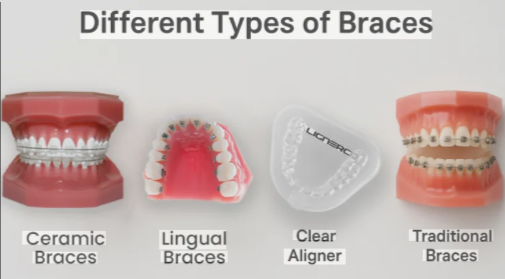
Types of Braces at a Glance
| Type | Visibility | Best for | Relative cost |
|---|---|---|---|
| Traditional metal | Visible | All cases, including complex ones | Most affordable |
| Ceramic | Tooth-coloured, less visible | Those wanting discretion with fixed braces | Higher than metal |
| Self-ligating | Visible or clear | Fewer, shorter adjustment visits | Higher than metal |
| Lingual | Hidden behind teeth | Complete discretion | Highest of fixed braces |
| Clear aligners | Nearly invisible | Mild to moderate cases, removable | Varies, often premium |
Types of Braces and Cost in Kenya: Comparison Table
| Type | Price at Elephant Dental Kiambu | Typical Kenya market range | Visibility | Best suited for |
|---|---|---|---|---|
| Traditional metal braces | From KSh 35,000 per jaw | KSh 30,000 to KSh 90,000 per jaw | Visible | Mild to complex cases, most affordable option |
| Ceramic braces | Ask for a quote | KSh 45,000 to KSh 120,000 per jaw (estimate) | Less visible, tooth coloured | Mild to moderate cases, patients wanting a subtler look |
| Self ligating braces | Ask for a quote | KSh 50,000 to KSh 130,000 per jaw (estimate) | Visible, smaller brackets | Patients wanting fewer adjustment visits |
| Clear aligners | Ask for a quote | KSh 150,000 to KSh 400,000 full treatment (estimate) | Nearly invisible | Mild to moderate spacing or crowding |
Braces by Treatment Time and Comfort
Two questions people ask constantly are which braces work fastest and which hurt the least. The honest answer is that treatment time depends far more on your specific case than on the bracket type, but there are real, general differences worth knowing. This table sets them out at a glance.
| Type | Typical treatment time | Comfort and pain |
|---|---|---|
| Traditional metal | 18 to 30 months | Effective for all cases; brackets can rub the cheeks at first |
| Ceramic | 18 to 30 months, similar to metal | Slightly smoother against the lip than metal for some patients |
| Self-ligating | Often fewer, shorter visits | Less friction; some patients find adjustments gentler |
| Lingual | 18 to 30 months | Hidden, but can irritate the tongue and affect speech at first |
| Clear aligners | Varies; mild to moderate cases can be faster | No brackets to rub; mild pressure for a few days per new tray |
No type is meaningfully painful in the way people fear. The discomfort comes from teeth moving, not the bracket material, so it is broadly similar across types, mild, temporary, and manageable. Our guide on whether braces hurt covers this in full.
Traditional Metal Braces
Metal braces remain the most common and most affordable type of braces in Kenya, and they are what Elephant Dental Kiambu offers starting from KSh 35,000 per jaw, with the exact figure confirmed in writing at a consultation. They consist of metal brackets bonded to each tooth, connected by an archwire that applies steady pressure to guide teeth into position. Metal braces are also the most versatile option, capable of correcting significant crowding, overbites, and crossbites that some other types struggle to manage on their own. For a full breakdown of what the price includes, see the braces price in Kenya guide.
Ceramic Braces
Ceramic braces work the same way as metal braces, brackets and an archwire, but the brackets are made from a tooth coloured material that blends in more with your natural teeth. They are noticeably less visible than metal braces while still being fixed in place for the duration of treatment, which makes them a middle ground for patients who want more discretion than metal but are not ready for the higher cost of clear aligners. Ceramic brackets are also slightly more fragile than metal, so care around very hard or sticky foods matters a little more.
One small but genuinely fun part of choosing traditional metal or self-ligating braces is picking your braces colors. The elastic ties holding the wire in place come in a wide range of colors, do not affect the price, and can be changed at every adjustment visit if you want variety. Our full braces price guide covers this in a bit more detail if color choice matters to you.
Colour choice genuinely comes down to personal preference, and most patients enjoy experimenting with a different one at each adjustment visit rather than settling on one for the whole treatment. Our full section below on choosing colours covers specific recommendations in more detail.
Self-Ligating Braces
Self-ligating braces use the same brackets-and-wire principle as metal braces, but each bracket holds the wire with a small built-in clip instead of an elastic tie. Fewer elastics means fewer parts to trap plaque and, for some patients, slightly quicker adjustment appointments. They sit above standard metal braces on price and roughly alongside ceramic, since the brackets themselves are usually still metal. Whether they suit your case depends on how much movement your teeth actually need, which a dentist can only tell you after an examination and X-rays.
Lingual Braces
Lingual braces are fixed to the inside surfaces of the teeth rather than the front, so from the outside they are close to invisible. That discretion is why people ask about them, and it is also why they cost more: each bracket has to be positioned on a curved inner surface, which takes longer in the chair and usually needs custom components. They also take some getting used to, since the brackets sit near the tongue for the first few weeks. Not every case can be treated this way, so this is one to raise at your consultation rather than plan around.
Clear Aligners
Clear aligners are removable plastic trays, worn in a planned sequence, that move teeth gradually without brackets or wires. You take them out to eat and to brush, which many adults prefer, and they are the least visible option of all. The trade-off is discipline: they only work while they are in your mouth, and most plans assume twenty to twenty-two hours of wear a day. Clear aligners also handle mild to moderate crowding more readily than complex bite problems, so the suitability question matters more here than with any other option.
Fashion Braces and Choosing Your Colours
Some patients ask about fashion braces, meaning braces worn for the look rather than to correct a bite. We do not fit appliances for cosmetic reasons alone, because anything bonded to a tooth changes how force travels through it, and an unsupervised appliance can move teeth in ways nobody planned. If the look is what appeals to you, the route is a proper assessment first. Where treatment turns out to be clinically appropriate, the colours come with it at no extra cost.
On colours, the elastic ties used with metal and self-ligating braces come in a wide range of shades, add nothing to the price, and can be changed at every adjustment visit. Darker blues and purples tend to make teeth look brighter by contrast. White and clear ties look discreet when fitted but show staining more obviously from strong tea, coffee and tomato-based food. Most patients try a different combination each visit rather than committing to one for the whole treatment.
Which of the Types of Braces in Kenya Suits Your Case
The honest answer is that the choice is usually narrower than it looks. Severe crowding, a significant overbite or teeth that need rotating tend to point towards fixed braces rather than aligners. Mild crowding, or relapse after previous treatment, opens up more options. Age matters too, since a growing jaw can be worked with in ways an adult jaw cannot. This is why we quote after an examination rather than over the phone: the types of braces in Kenya that are genuinely available to you depend on what your X-rays show.
A consultation at our Kiambu clinic covers the examination, X-rays where they are needed, and a written treatment plan listing the options that actually apply to your case with the cost of each. You leave knowing which of the types of braces in Kiambu we can offer you, what each would cost per jaw, and roughly how long it would take, before committing to anything.
What the Price Per Jaw Actually Covers
Braces in Kenya are normally priced per jaw, which is the single biggest reason quotes look so different from one another. A figure quoted for one jaw will roughly double if both need treating, so always check which you are being quoted for. At our Kiambu clinic, braces start from KSh 35,000 per jaw for standard metal, with ceramic, self-ligating, lingual and clear aligner options costing more, and complex cases running considerably higher.
A complete quote should also tell you what is bundled in: the fitting appointment, the routine adjustment visits through treatment, and the retainer you will need afterwards to hold the result. Retainers are the item patients most often leave out of their budget, and they are not optional. Ask for the figure in writing, itemised, so you can compare the types of braces and cost in Kenya on the same basis from one clinic to the next.
Frequently Asked Questions About Types of Braces
Which type of braces is fastest?
Treatment time depends far more on how far your teeth have to move than on which appliance moves them. A mild case in aligners and a mild case in metal braces often finish within a similar window, while a complex case takes longer in either. Anyone quoting a timeline before looking at X-rays is guessing.
Are ceramic braces worth the extra cost?
That depends on how much the visibility matters to you, which is a personal call rather than a clinical one. Ceramic brackets blend in noticeably better than metal and cost more, and they are a little more fragile. Both move teeth by the same mechanism.
Can I switch types partway through treatment?
Sometimes, though it usually adds both cost and time, and it is not possible in every case. It is far better to settle the question at the planning stage.
Do all the types of braces cost the same per jaw?
No. Metal is the starting point, and ceramic, self-ligating and lingual braces and clear aligners each cost more for different reasons. The written plan you get after your consultation lists the figure for every option that applies to you.
Book a Consultation in Kiambu
We are on the 8th floor of Kikinga House on Biashara Street in Kiambu, opposite Kiambu Level 5 Hospital, open 8am to 5pm every day. Send a message on WhatsApp to 0143 178126 describing what is bothering you and we will arrange a time. Bring any previous X-rays if you have them.
One Response