Dentures cost in Kenya typically range from KSh 10,000 to well over KSh 100,000, depending on whether you need a partial or full set, the material used, and whether the denture is anchored to implants. If you are missing one or more teeth and weighing your replacement options, this guide walks through the different types of dentures, honest price ranges gathered from clinics across Kenya, and what actually happens at a consultation, not a sales pitch, just what is worth knowing before you decide anything.
If you are searching “dentures cost in Kenya” because a tooth is already gone, or your dentist has told you an extraction is coming, you likely want two things: a realistic price range, and a plain-language explanation of what dentures actually involve day to day. This guide covers both, along with the questions worth asking before you commit to any provider. If you would rather skip ahead and talk to someone directly, you can also reach out for a consultation at any point.
Types of Dentures Explained
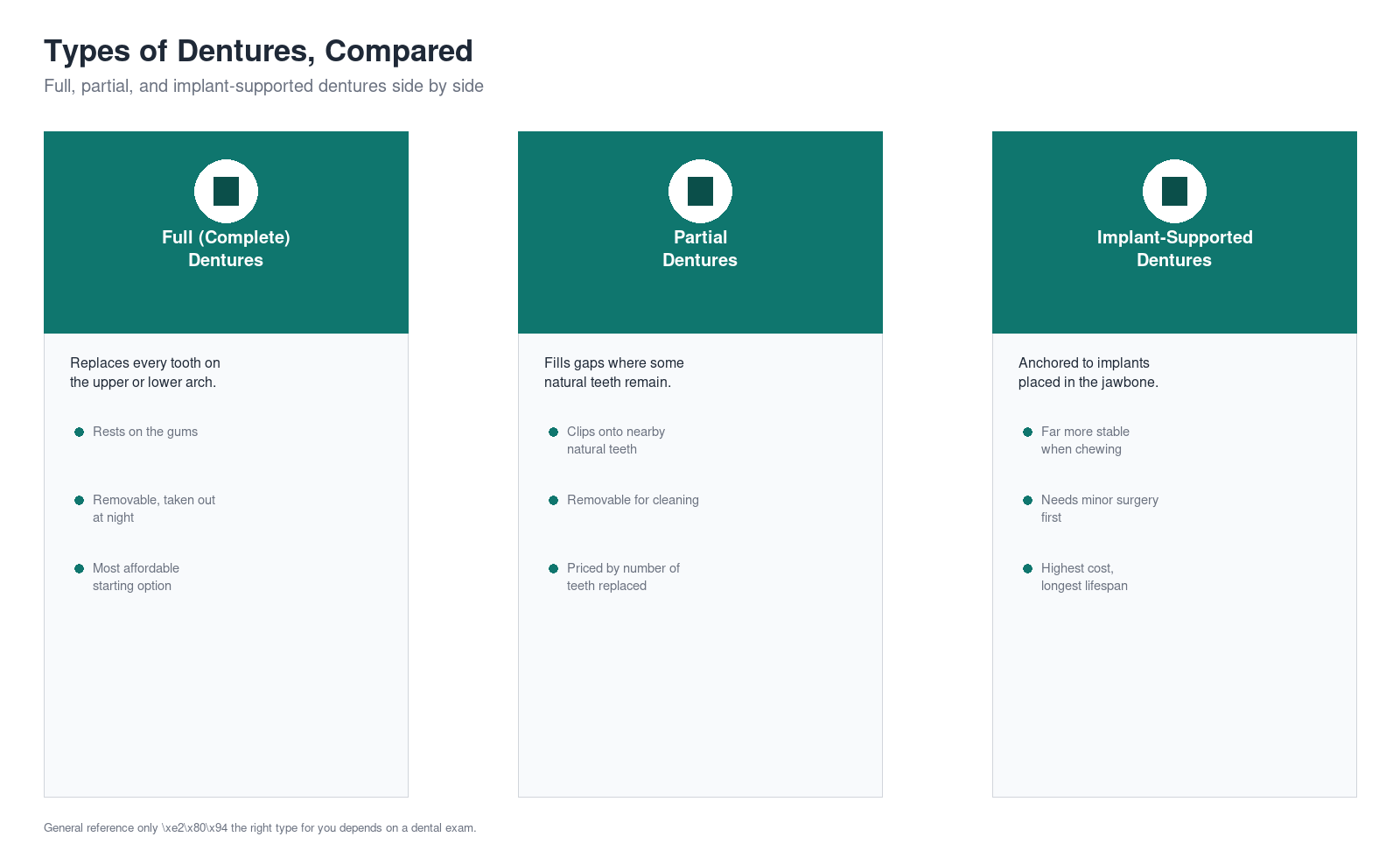
Full (complete) dentures replace every tooth on the upper arch, the lower arch, or both. They rest directly on the gums, held in place by suction and the natural contours of your jaw, and are removed at night. This is generally the most affordable starting option, and the one most people picture when they hear the word “denture.”
Partial dentures fill the gaps left by missing teeth when some of your natural teeth remain healthy enough to keep. A partial clips onto the neighbouring natural teeth for stability and is removable for cleaning. Price generally scales with how many teeth are being replaced.
Implant-supported (implant-retained) dentures anchor to a small number of implants placed in the jawbone rather than resting on the gums alone. This makes them considerably more stable for biting and chewing, at a higher cost and with minor surgery involved upfront. Some patients start with a conventional denture and move to an implant-supported one later, once budget allows.
The NHS’s patient guidance on dentures describes broadly the same three categories, which is a useful independent reference if you want to read further before your own consultation.
There is no single “best” type across the board. The right one depends on how many teeth you are replacing, the condition of your remaining teeth and gums, your budget, and how much stability you need, questions a consultation answers far better than a general guide can.
Dentures Cost in Kenya: Price Table by Type
| Denture type | Typical Kenya price range (per jaw) |
|---|---|
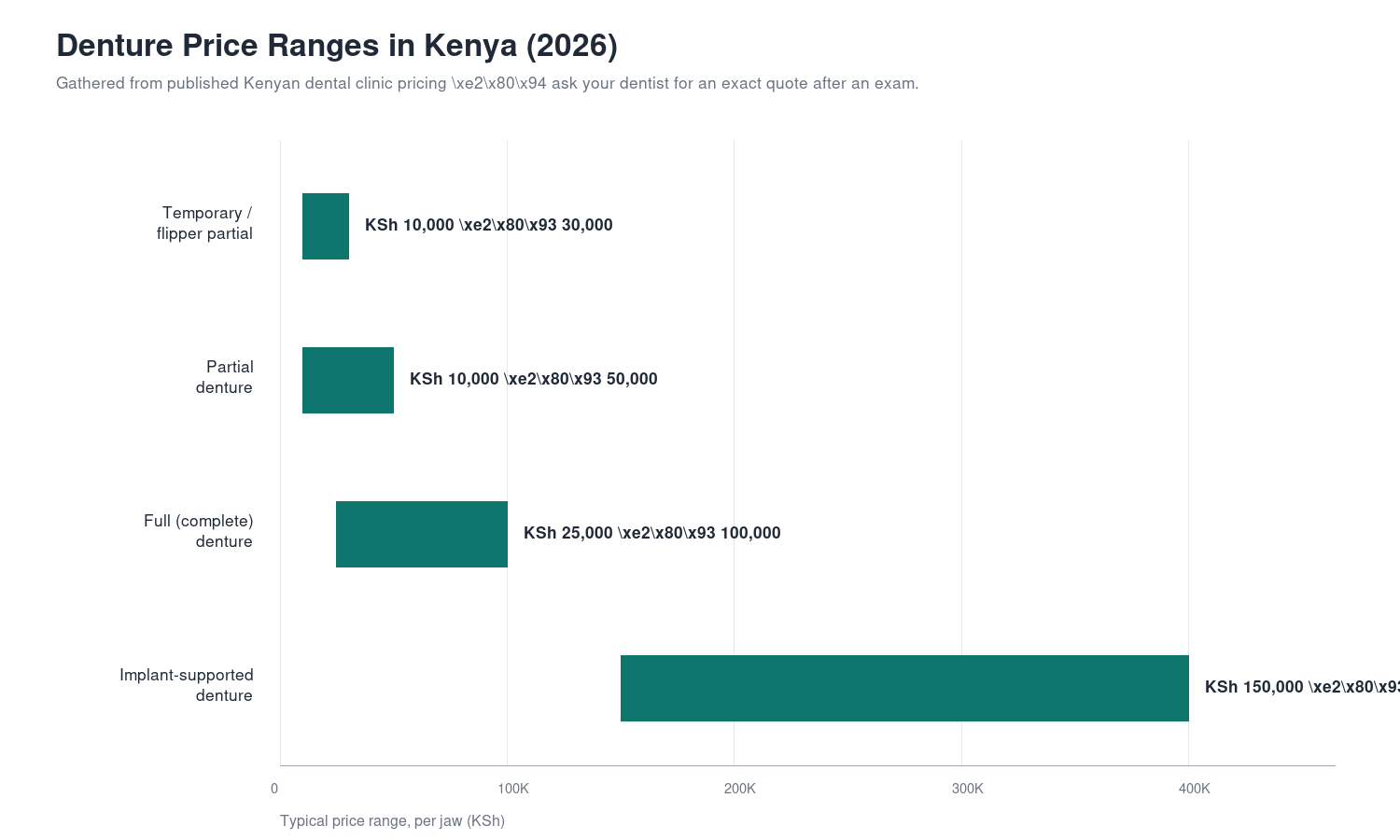
| Temporary / flipper partial | KSh 10,000 to KSh 30,000 |
| Partial denture | KSh 10,000 to KSh 50,000 |
| Full (complete) denture | KSh 25,000 to KSh 100,000+ |
| Implant-supported denture | KSh 150,000 to KSh 400,000+ |
These ranges are gathered from published pricing across several Kenyan dental clinics and cost guides, not from a single provider, and they move depending on materials, the number of teeth involved, and your specific case. A single missing tooth replaced with a small partial sits at the low end; a full set built on implants sits at the high end. The only way to get an exact number for your situation is a dental exam, since a dentist quoting without looking at your mouth is guessing the same way this article is.
Partial Denture Prices by Material
For partial dentures specifically, the material makes a real difference to both the price and the comfort, and it is worth understanding the tiers rather than treating partials as one thing. Acrylic is the most affordable; flexible and cast metal cost more but last longer and often feel better.
| Partial denture material | Typical Kenya price | What to know |
|---|---|---|
| Acrylic (plastic) partial | KSh 10,000 to KSh 25,000 | Most affordable, uses visible metal clasps, lasts around 3 to 5 years |
| Flexible (Valplast) partial | KSh 25,000 to KSh 45,000 | Lightweight nylon, no visible metal clasps, more comfortable |
| Cast metal (chrome-cobalt) partial | KSh 40,000 to KSh 70,000 | Thinner, stronger, longer-lasting framework, lasts around 7 to 10 years |
These are market ranges for planning. Your exact dentures cost in Kenya depends on how many teeth are being replaced and the material chosen, which is confirmed after an examination.
Why Denture Prices Vary So Much in Kenya
Material matters. Standard acrylic dentures cost less than flexible or metal-framed alternatives, which tend to be thinner, lighter, and more durable, at a higher price.
How many teeth you are replacing changes the work involved. A single-tooth partial is a smaller job than a full arch, and price generally scales with it.
Implant-supported options cost significantly more than removable dentures. Placing implants is minor surgery, and each implant adds to the total, which is why implant-supported dentures sit at the far end of the price range.
Location and lab fees play a role too. Clinics in expensive commercial areas carry higher overheads, which shows up in what they charge, and dentures are typically built by an off-site dental lab, whose fees are part of the final price regardless of which clinic you choose.
How many adjustment visits are bundled into the price affects the real total. A lower headline number that only covers the denture itself, with every fitting visit billed separately, is not automatically cheaper than a higher number that includes them. This is worth asking directly at any clinic you are comparing, not assuming from the first figure you are given.
Signs You May Need Dentures
A few situations consistently lead people toward dentures as an option worth discussing. One or more missing teeth that are affecting how you chew or speak. A dentist recommending extraction for a tooth that cannot realistically be saved. An old, ill-fitting denture that has become loose, uncomfortable, or visibly worn. Difficulty eating certain foods because there is nothing left to bite down with on one side. None of these mean dentures are automatically the right answer, other replacement options exist too, but any of them is a reasonable reason to book an exam and find out what your options actually are.
Immediate Dentures: What Happens Right After an Extraction
If a tooth needs to come out, you do not necessarily have to walk around with a gap while a permanent denture is being made. An immediate denture is fitted on the same day as the extraction, giving you something to wear through the initial healing period rather than waiting weeks with missing teeth. It is generally treated as a temporary solution, since your gums and jawbone continue to change shape as they heal after an extraction.
This means an immediate denture usually needs relining or replacing with a permanent one once healing settles, typically after a few months. The upside is functional and social: you are not left without teeth in the meantime. The trade-off is that an immediate denture is rarely the final fit, and most people budget for a second, better-fitting denture once healing is complete.
Dentures vs Dental Implants: How They Compare
Dentures and dental implants both replace missing teeth, but they work very differently, and the right choice depends on your priorities as much as your budget.
Upfront cost favours dentures, which cost meaningfully less than implants, especially for replacing several teeth at once. Durability favours implants, which can last 20 years or more with proper care, compared with roughly 5 to 10 years for a conventional denture before it needs relining or replacing as your jawbone gradually changes shape. Stability while eating favours implants, since they are fixed in the jawbone rather than resting on the gums. Recovery favours dentures, since fitting one does not involve surgery, while implants need a healing period after placement. Neither option is universally better; it depends on how many teeth you are replacing, the health of your jawbone, and what you are willing to spend upfront versus over time.
Which Type of Denture Is Best, Strongest, and Most Comfortable?
There is no single best denture for everyone, the right choice depends on how many teeth you are replacing, your budget, and what matters most to you, comfort, appearance, or durability. That said, here is the honest comparison people are really asking for.
Most comfortable: Flexible (Valplast) partial dentures are widely considered the most comfortable removable option, since the lightweight nylon has no rigid metal clasps and adapts closely to the gums. Strongest and most durable: Cast metal (chrome-cobalt) partials have the strongest, thinnest framework and typically last longest among removable options. Most stable overall: Implant-supported dentures are the most stable of all, since they anchor to the jaw rather than resting on the gums, though they are also the most expensive. Most affordable: Acrylic dentures do the job at the lowest cost, which is why they remain the most common choice.
The genuinely useful answer for your situation comes from an exam, since the best denture for a single missing tooth is different from the best full-arch solution. A quick WhatsApp message describing your case is the fastest way to a real recommendation.
How Long Do Dentures Last
Most dentures last around 5 to 10 years with proper care, though this varies by individual. The denture itself does not simply wear out on a fixed schedule; the more common issue is that your jawbone and gums gradually change shape over years, particularly after tooth loss, which means a denture that fit perfectly at first can loosen over time even if the appliance itself is still in good condition. Regular check-ins with your dentist catch this early, and a reline, an adjustment to the fit rather than a full replacement, often solves it without needing an entirely new denture.
Caring for Your Dentures: Daily Maintenance
Dentures need daily care, just not the same routine as natural teeth. Rinse them after eating to clear food particles, and brush them daily with a soft brush and a non-abrasive denture cleaner rather than regular toothpaste, which can be too harsh for the material. Take them out at night and soak them in water or a denture-cleaning solution, since drying out can cause them to lose their shape.
Handle them over a folded towel or a basin of water, since dropping a denture on a hard surface is one of the most common ways they crack. And keep up with dental check-ups even after getting dentures; your gums, jawbone, and any remaining natural teeth still need monitoring.
Can You Eat and Speak Normally With Dentures
Yes, most people return to eating and speaking normally with dentures, but both take an adjustment period, often a few weeks. Starting with softer foods cut into small pieces, and chewing evenly on both sides of your mouth rather than favouring one side, makes the transition easier. Certain sticky or very hard foods are worth avoiding, or at least approaching carefully, even once you are used to wearing dentures. Speech usually adjusts within a couple of weeks as your tongue and cheeks learn the new shape in your mouth; reading aloud at home is a common, genuinely effective way to speed this up.
Common Myths About Dentures
A few myths about dentures persist despite being outdated. The first is that dentures always look fake or obviously artificial; modern dentures are shaped and shaded to match your natural gums and remaining teeth, and a well-fitted one is far less noticeable than older styles from decades past. The second is that dentures are only for elderly patients; while age-related tooth loss is common, dentures are fitted at any age when teeth are missing or need replacing, for reasons ranging from injury to decay to gum disease.
The third myth is that once you have dentures, you no longer need dental visits; the opposite is true, since your gums, jawbone, and any remaining natural teeth still need regular monitoring, and the denture itself needs periodic adjustment as your mouth changes over time.
What to Expect at a Denture Consultation
A first denture consultation generally follows a similar pattern wherever you go. The dentist examines your remaining teeth, gums, and jawbone, and asks about your medical history and any denture experience you have had before. If a full or partial denture looks like the right direction, impressions of your mouth are taken to build a model the denture is shaped around.
Several fitting appointments usually follow before the final denture is ready, since getting the fit right takes more than one visit, and most providers build in at least one adjustment appointment afterward for the sore spots that commonly show up once you start wearing it day to day.
None of this is unique to any single clinic; it is simply how the process works. It is worth confirming upfront how many fitting and adjustment visits are included in any price you are given, since that materially affects what you end up paying in total.
Finding Dentures Near You: Nairobi, Ruiru, and Ruaka
If you have been searching for dentures cost in Kenya from Nairobi, Ruiru, or Ruaka specifically, you are in one of the better-served parts of the country for dental care, which also makes it harder to compare providers. Ruaka sits along the Limuru Road and Kiambu Road corridor, close to Banana and Ridgeways, putting a short drive within reach of clinics in both Kiambu Town and Nairobi’s northern suburbs. Ruiru sits along Thika Road, and residents there commonly weigh clinics along that corridor against options further into Nairobi or out toward Kiambu Town.
Wherever you are searching from, the same basics apply everywhere: get a written quote after an exam rather than a phone estimate, ask exactly what is included in that number, and confirm how many fitting and adjustment visits come with the price before you commit to anything.
Elephant Dental Kiambu sits on Biashara Street in Kiambu Town, within easy reach of the Kiambu Road corridor from Ruaka and the Thika Road corridor from Ruiru, and is a straightforward option for anyone in Nairobi’s northern suburbs who would rather start with a local consultation than travel further into the city.
Questions Worth Asking Before You Commit to Dentures
A short list of questions is worth taking to any provider you are considering, not just one. What material is the denture made from, and why is it recommended for your case? Is the quoted price fixed in writing after an exam, or a rough estimate given sight unseen? How many fitting and adjustment visits are included before the denture is considered finished?
What is the realistic timeline from impressions to a finished denture? And has an implant-supported option been discussed, even if it is not what you end up choosing, so you know what you are trading off. A provider willing to answer these clearly before you commit to anything is generally a good sign of how the rest of the process will go. You can also see the fuller range of restorative dental options for context on how dentures compare with other ways of replacing a tooth.
Frequently Asked Questions About Dentures in Kenya
How much do dentures cost in Kenya? Partial dentures typically cost KSh 10,000 to KSh 50,000, full dentures KSh 25,000 to KSh 100,000 or more, and implant-supported dentures KSh 150,000 upward, depending on materials and how many teeth are involved. A consultation gives you an exact figure for your situation.
Which type of denture is best? There is no single best type. It depends on how many teeth you are replacing, the condition of your gums and jawbone, your budget, and how much stability you need day to day, which is exactly what a dental exam is for.
Can I eat with dentures? Yes, after an adjustment period of a few weeks. Starting with softer foods and chewing evenly on both sides makes the transition smoother.
How long do dentures last? Around 5 to 10 years on average, though your jawbone changes shape over time, which is usually what affects fit before the denture itself wears out.
What are “4-in-1” dentures? This is not a standardised clinical term. It is generally used to describe a partial denture replacing up to four missing teeth in one arch, though some providers use it loosely for other combination solutions. Ask any clinic quoting this term to explain exactly what it includes before comparing it to other prices.
Does SHA cover dentures or dental treatment in Kenya? Dental care, including dentures, is currently excluded from the Social Health Authority’s standard benefits package for most Kenyans. Civil servants under the comprehensive cover scheme generally have some dental benefit. It is worth confirming directly with your specific SHA cover what, if anything, applies to your situation.
Do dentures fall out easily? A well-fitted denture should not fall out during normal eating or speaking, though it can feel loose in the first weeks while you adjust. Persistent looseness usually means the fit needs checking rather than something you should just get used to.
How do dentures stay in if I have no teeth at all? Full dentures rely on suction and the natural contours of your gums and jawbone to stay in place, sometimes with the help of a denture adhesive. If stability remains a persistent problem, an implant-supported denture anchored to a small number of implants is the more secure option.
How much do 1 or 2 tooth dentures cost? A small partial replacing one or two teeth sits at the lower end of the range, often from around KSh 10,000, depending on the material. Acrylic is cheapest; a flexible or metal-framed partial for the same gap costs more but lasts longer and feels better.
Can dentures last 20 years? Some do, but it is not the norm. Well-made dentures typically last 5 to 10 years before needing replacement or relining, because your gums and jawbone naturally change shape over time and the fit loosens. With excellent care and periodic adjustments, a set can last considerably longer, but planning for a reline or replacement within a decade is realistic.
What is a better option than dentures? For many people, dental implants or an implant-supported denture offer greater stability and a more natural feel, since they anchor to the jaw rather than resting on the gums. They cost more and require surgery, so they are not better for everyone, but if budget allows and your jawbone is healthy, they are worth discussing. A bridge is another fixed alternative for a smaller number of missing teeth.
Start Your Denture Journey
You do not need to have already decided between full, partial, or implant-supported dentures before you book anything. That decision is exactly what a consultation is for, a dentist examining your mouth directly will tell you more than any article, including this one. If missing teeth have been affecting how you eat, speak, or smile, and you are within reach of Nairobi, Ruiru, Ruaka, or Kiambu Town, the way to start is a consultation at Elephant Dental Kiambu on Biashara Street. Message on WhatsApp to ask a question or book a time, there is no obligation to go further than that first conversation.
Looking to book rather than compare? Our dentures in Kiambu page covers what the treatment involves, what it includes and how to book a consultation.
Book a Denture Consultation on WhatsApp
2 Responses