Teeth whitening vs teeth masking is not actually a choice between two similar treatments, they solve different problems. Whitening uses a bleaching agent to change the natural colour of your existing enamel. Masking applies a tooth coloured composite resin directly onto the tooth surface to cover stains, chips, gaps, or discoloration that whitening cannot reach. At Elephant Dental Kiambu, both are priced at KSh 2,000 per tooth, which makes the real question not which costs less, but which one actually fixes what is bothering you.
If you have been searching this comparison because you are not sure which treatment applies to your situation, this guide walks through exactly what each one does, so you book the right treatment the first time rather than paying for one that was never going to solve your specific problem.
Why This Comparison Confuses So Many People
Part of the confusion comes from how loosely “masking” gets used across different dental websites. Some clinics use the term to describe veneers, others use it for crowns, and others use it for bonding, three genuinely different procedures with different costs and permanence. In Kenya specifically, “teeth masking” most commonly refers to a composite resin bonding procedure, a tooth coloured material sculpted directly onto the visible surface of a tooth, hardened with a curing light, and polished to blend with your natural teeth. It is not a whitening technique, and it will not lighten teeth the way bleaching does. Clearing this up before you book saves you from paying for the wrong treatment entirely.
Teeth Whitening vs Teeth Masking: Quick Comparison Table
| Factor | Teeth whitening | Teeth masking |
|---|---|---|
| What it actually does | Changes the colour of existing enamel through bleaching | Covers the tooth surface with new tooth coloured material |
| Price at Elephant Dental Kiambu | KSh 2,000 per tooth | KSh 2,000 per tooth |
| Fixes overall yellowing or dullness | Yes, this is what it is designed for | Not efficiently, better suited to a single tooth |
| Fixes a chip or gap | No | Yes |
| Fixes a single badly discoloured tooth | Sometimes, depends on the cause | Often, especially for intrinsic staining |
| Works on crowns, veneers, or fillings | No | Can help disguise a mismatch |
| Reversible | Not applicable, it is a chemical change | Yes, can be removed or redone |
| Typical duration before touch-up needed | Six months to two years | Several years with reasonable care |
What Teeth Whitening Actually Does
Whitening uses a peroxide-based bleaching agent, hydrogen peroxide or carbamide peroxide, to break down the compounds inside your tooth enamel that cause discoloration. This changes the actual colour of your natural tooth, not just what sits on the surface. It works well for overall yellowing from coffee, tea, or ageing, and for surface staining that a regular cleaning has not already addressed. Its major limitation is that it only works on natural enamel, it does nothing for crowns, veneers, fillings, or a tooth that has died internally and darkened for reasons whitening cannot reach. Our full teeth whitening price guide covers this treatment in complete detail, and if you are also deciding between an in-clinic session and an at-home kit, our professional vs at-home whitening comparison breaks that down separately.
What Teeth Masking Actually Does
Masking works completely differently. Rather than changing the tooth’s existing colour, a dentist applies a composite resin material directly onto the visible surface of the tooth, shapes it to correct the specific flaw, hardens it with a curing light, and polishes it to match the surrounding teeth. This means masking can fix things whitening genuinely cannot: a chipped edge, a small gap between two front teeth, an oddly shaped tooth, or a single tooth that has darkened due to an old injury rather than surface staining.
It is also the option worth considering if you have a crown or filling on a front tooth that no longer matches your other teeth after whitening, since masking can help disguise that mismatch in a way whitening structurally cannot.
How Masking Compares to Veneers and Crowns
Masking sits in an interesting middle ground. Veneers are thin porcelain or composite shells that cover the entire front surface of a tooth, more durable and more expensive, and usually involve removing a small amount of enamel to fit properly. Crowns cover the entire tooth, used for more significant damage or after treatments like a root canal, and are the most involved and most expensive of the three options. Masking, by comparison, is faster, more affordable, and reversible, since it does not require removing tooth structure the way veneers typically do. It is a reasonable middle step for a patient who wants to fix a specific cosmetic issue without committing to a more permanent, more expensive restoration.
Which One Do You Actually Need
If your main concern is that your teeth generally look duller or more yellow than you would like across most or all of your smile, whitening is almost always the more efficient and appropriate treatment, and masking each tooth individually to achieve the same effect would be slower and more expensive for no added benefit.
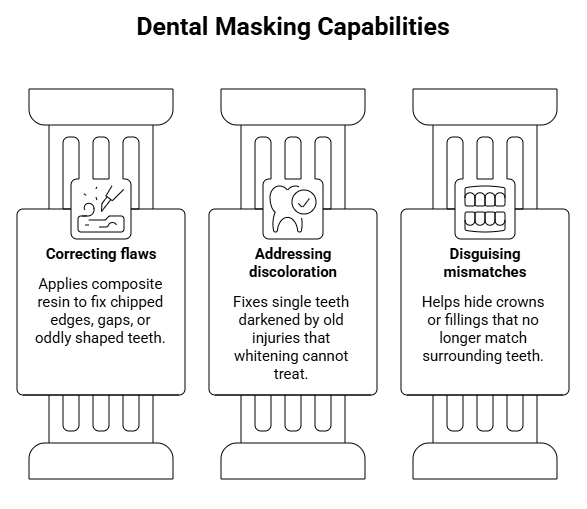
If your concern is a single problem tooth, a chip, a gap, an oddly shaped tooth, or a tooth that stayed dark even after a cleaning, masking is very likely the treatment that actually addresses it, since whitening alone will not change that tooth’s shape or fix damage that has nothing to do with surface colour. Some patients genuinely benefit from both, whitening the overall smile and masking one specific problem tooth that whitening could not fully address on its own.
Can You Combine Whitening and Masking
Yes, and for some patients this is actually the ideal approach. A common sequence is whitening first, since this establishes your natural teeth’s brightest achievable shade, followed by masking on any specific tooth that still needs correcting, matched precisely to that new, brighter shade rather than your original colour. Doing it in the reverse order risks a masked tooth that no longer matches once the rest of your smile is whitened afterward, which is exactly the kind of detail worth discussing at your consultation rather than assuming either treatment happens in isolation.
An Illustrative Example
This is an illustrative scenario to make the decision concrete, not a real patient case. Consider someone with generally yellow teeth from years of tea drinking, plus one front tooth that chipped years ago and has always looked slightly different from the others. Whitening alone would brighten the overall smile but do nothing for the chip. Masking the chipped tooth alone would fix that one tooth but leave the rest of the smile looking dull by comparison. The combined approach, whitening the full smile and then masking the chipped tooth to match the new shade, addresses both problems rather than solving one and ignoring the other.
Is Masking Safe for Everyone
Masking is generally a safe, minimally invasive procedure, since it does not usually require removing significant tooth structure the way a crown or veneer often does. It is a reasonable option for younger patients not yet ready for a more permanent restoration, and it can be redone or adjusted over time as needed. That said, a proper exam still matters, since a tooth with an underlying issue, active decay, a crack extending below the gumline, or a problem affecting the tooth’s root, needs that issue addressed first rather than simply covered over cosmetically.
Does Masking Stain the Way Natural Teeth Do
Composite resin used in masking is more resistant to staining than natural enamel, but it is not entirely stain proof, particularly with heavy coffee, tea, or tobacco use over years. Unlike whitening, which changes your natural enamel and can theoretically be repeated as needed, a masked tooth that has picked up staining over time is typically refreshed by polishing or, eventually, replacing the composite material rather than through a whitening treatment, since whitening agents do not affect composite resin the way they affect natural enamel.
A proper exam remains the only reliable way to settle teeth whitening vs teeth masking for your specific concern.
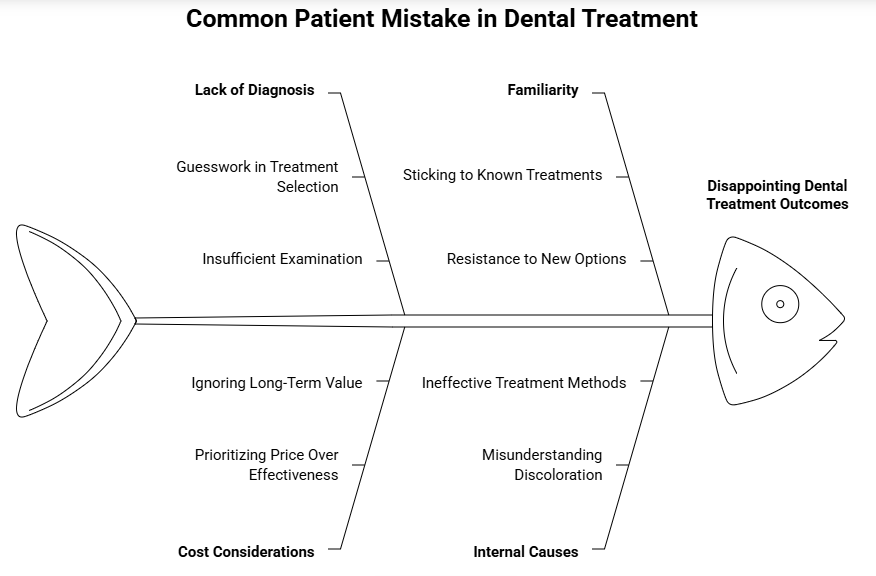
The Most Common Mistake Patients Make
The single most common mistake is booking whichever treatment sounds cheaper or more familiar without actually knowing what is causing the specific concern.
How Long Each Treatment Actually Takes at the Dentist
Whitening and masking also differ meaningfully in how much chair time they require. A whitening session typically takes around an hour for a full treatment, since the gel is applied and left to work across multiple teeth simultaneously. Masking takes longer per tooth, since each one is individually shaped and polished by hand, often twenty to forty minutes for a single tooth depending on the complexity of the correction needed. If you are masking several teeth in one visit, this adds up, which is worth factoring into how you schedule your appointment.
Working through teeth whitening vs teeth masking with your dentist directly tends to be faster than researching it alone.
Candidacy: Who Should Consider Each Treatment
Whitening suits someone with generally healthy natural teeth and gums who wants an overall shade change, and is not a good fit for anyone with active decay or gum disease, which should be treated first. Masking suits someone with a specific, localised concern, a chip, gap, or single discoloured tooth, and works well even for younger patients not yet ready for a more permanent restoration like a veneer or crown. Masking is also often a reasonable interim option for a tooth that eventually may need a crown, buying time with a less invasive, more affordable fix in the meantime.
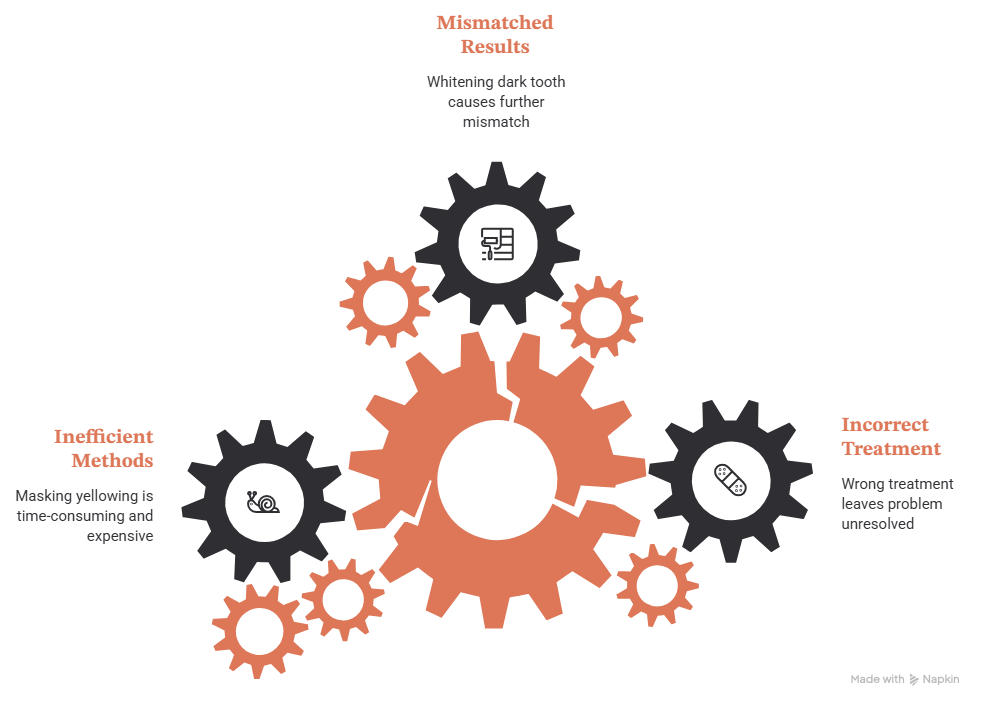
What Happens if You Choose the Wrong Treatment
Caring for Masked Teeth vs Whitened Teeth
Aftercare differs slightly between the two. Masked teeth benefit from avoiding very hard foods that could chip the composite material, similar to caring for a filling, along with regular brushing and flossing as normal. Whitened teeth benefit most from avoiding heavy staining foods and drinks in the days immediately following treatment, since enamel is temporarily more porous right after bleaching. Both benefit from routine professional cleaning, which helps either result stay looking its best for longer. Read more here>>>
What the Price at Elephant Dental Kiambu Includes
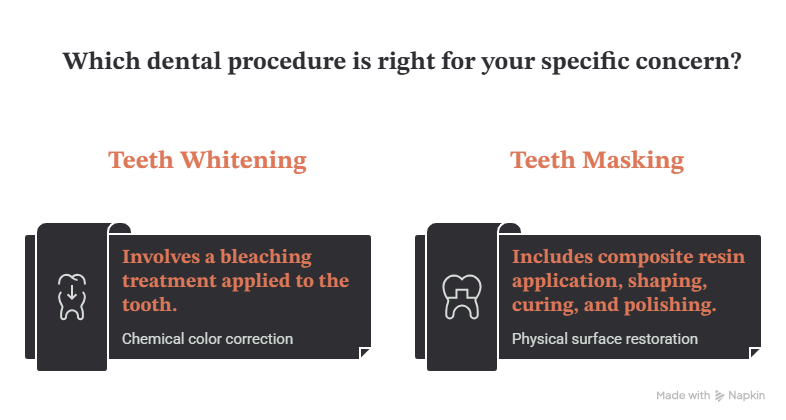
Both treatments are priced at KSh 2,000 per tooth, though what that covers differs given the different nature of each procedure. For whitening, the price covers the bleaching treatment applied to each tooth you choose to have whitened. For masking, the price covers the composite resin application, shaping, curing, and polishing for each individual tooth being masked. Both are confirmed in writing after an exam, so you know your exact price before either treatment begins, and the exam itself is what determines which treatment your specific concern actually needs.
The Bottom Line on Teeth Whitening vs Teeth Masking
These are two different tools for two different problems, not competing options for the same one. Whitening changes your overall tooth colour. Masking rebuilds a specific tooth’s surface to fix a localised flaw. Knowing which problem you actually have, general dullness versus a specific chip, gap, or stubborn dark tooth, is what determines which treatment is worth booking, not price, and not which term you happened to search first.
How Much Is a Full Set of Teeth Whitening?
When people ask about a full set of teeth whitening, they usually mean whitening all the visible upper and lower front teeth, which is what a standard whitening treatment covers anyway, since those are the teeth that show when you smile. Whitening is priced as a treatment rather than per tooth, so a full set is simply the normal session. Masking treatments like bonding or veneers are different, they are priced per tooth, which is why covering several teeth with those adds up far faster than whitening. This is one of the biggest cost differences between whitening and masking, and the right choice depends on whether your teeth need a colour change, which whitening handles affordably, or a shape and colour change, which masking handles at a higher per-tooth cost. Your exact price for either is confirmed at a consultation.
What Is the Cheapest Way to Whiten Teeth?
The cheapest way to whiten teeth that genuinely works is usually a professional cleaning followed by whitening, rather than repeatedly buying shop kits that underdeliver. It sounds counterintuitive that the professional route can be cheaper, but people often spend more over time on charcoal pastes, strips, and gimmick kits that do little than they would have on one supervised treatment that works. Masking is never the cheap option, it is a bigger cosmetic treatment for teeth that need reshaping, not just brightening. If budget is your main concern and your teeth are basically well shaped but stained, whitening is almost always the more affordable path, and a consultation will tell you honestly whether that describes your teeth.
Whitening and Masking at a Clinic Along Kiambu Road
For anyone searching along the Kiambu Road corridor, both whitening and masking options can be assessed at Elephant Dental Kiambu on Biashara Street in Kiambu town. Having both looked at in one consultation matters, because the honest answer to which you need often only becomes clear after a dentist sees your teeth, and getting that assessment locally rather than in central Nairobi keeps any follow up close to home. The clinic is open seven days a week including Sundays.
Why Patients Choose Elephant Dental Kiambu for This Decision
Elephant Dental Kiambu is a KMPDC-registered dental practice on Biashara Street, with patients consistently mentioning unhurried explanations and visible sterilisation between patients. Every case is personally assessed by Dr. Winny before recommending whitening, masking, or both, working within the wider Elephant Dental network, so the recommendation is based on what your specific teeth actually need rather than a default answer. Every step is explained clearly before it happens, including which treatment addresses which part of your concern.
The clinic is open seven days a week, 8am to 5pm, including Sundays, at Kikinga House on Biashara Street, a short walk from Kiambu Town Main Stage.
How much is a full set of teeth whitening? Whitening is priced as one treatment covering the visible upper and lower front teeth, not per tooth, so a full set is the standard session. Masking like bonding or veneers is priced per tooth and costs more. Your exact price is confirmed at a consultation.
What is the cheapest way to whiten teeth? Usually a professional cleaning followed by supervised whitening, rather than repeatedly buying shop kits that underdeliver. Masking is never the cheap option, as it reshapes teeth rather than just brightening them.
Frequently Asked Questions About Teeth Whitening vs Teeth Masking
Is teeth masking a type of whitening? No. Teeth masking is a composite resin bonding procedure that covers the tooth surface, while whitening is a chemical bleaching process that changes the tooth’s existing colour. They work completely differently.
Can teeth masking fix a chipped tooth? Yes. This is one of the main things masking can do that whitening cannot, since masking rebuilds the tooth’s shape with composite resin rather than only changing its colour.
Will whitening work on a tooth that already has masking applied? No. Whitening agents affect natural enamel, not composite resin, so a previously masked tooth will not lighten further with a whitening treatment.
Which is more expensive, whitening or masking? At Elephant Dental Kiambu, both are priced the same, KSh 2,000 per tooth. The right choice depends on which problem you are actually trying to fix, not which costs less.
Can I get both treatments done together? Yes, and for some patients this is the ideal approach, typically whitening first to establish the brightest natural shade, followed by masking any specific tooth that still needs correction to match.
Not Sure Which Treatment You Need
You do not need to diagnose this yourself. Message Elephant Dental Kiambu on WhatsApp and describe what is bothering you about your smile, and the team will give you an honest first read on whether whitening, masking, or both is the right fit, with no obligation to book anything further. If it makes sense to move forward, the next step is a full oral exam, which confirms the right treatment and gives you a fixed, written price. You can also call 0143 178126 directly, or use the booking calendar on the clinic’s contact and directions page.
If whitening turns out to be the right treatment for your teeth, our teeth whitening in Kiambu page covers the price, the process and who should avoid it.
Ask Which Treatment I Need on WhatsApp